domenica 26 luglio 2015

THE MESH, by Lisa Gansky

THE MESH


By Lisa Gansky


As its tagline forecasts, this book is very business-oriented. You may consider taking one of the previous readings I reviewed if you find yourself more on the side of the consumer, since here you will more likely find out how to mesh up your business and not your life.

So first of all, WHAT is the MESH? I'm pretty sure that there is no better person than the author Lisa Gansky to explain this concept since she is the mind behind its conception. So if you want to make sure you catch up with the real meaning, get the book and give yourself your own interpretation of it.


More concretely, as the author writes "Mesh businesses share four characteristics: sharing, advanced use of Web and mobile information networks, a focus on physical goods and materials, and engagement with customers through social networks". Whereas a "Mesh Design - referred to products - is: Durable, Flexible, Reparable and Sustainable".

After these quotations, it seems clear that the Mesh concept finds its best use in association with the words "business model". However, one of the core characteristics, the one referring to the focus on physical goods, has already got old fashion since the book was pubblished in 2010. Right now, in 2015, I don't think it would be appropriate to state that the materiality of a resource could be associated to its "meshing" nature, the Mesh has got literally everywhere, ranging from skills and competencies to patents, making physical products just a part of it.

What is still to be said, is that the Mesh, just as the sharing economy (someone says they are synonim and I partially agree), shifts the focus from ownership to access, hence representing one of the biggest economic trends of our century.

On my opinion, the reading is quite pleasant but it somehow lacks a little bit of boldness, moreover some more data should have been provided, statistics are sexy and could represent a good of the reading experience. At some point, I think the author confuses the Mesh with one of its attributes: Sustainability. For instance I could think of saying Walmart is getting more sustainable, but I would definitly avoid referring to Walmart when talking about the Mesh, because for me the Mesh is more than that.

Once again, I do recommend this book! Although I'm not fully satisfied with the reading, I do recognize that it is a major work on the topic, and also one of the first of a long series. Don't miss the Mesh Directory at the end of the book, a section plenty of great meshed up businesses - some of them already out of business - to discover!

Make sure you read this book before:
  • starting your own Mesh business;
  • writing a paper on the sharing economy;
  • criticizing mesh businesses for unfair competition.

Best quotations on my opinion:

"Trust is social, which makes all business social; Mesh businesses are hypersocial".

"But like our minds, the Mesh is much greater than the sum of its parts."

_______________________________________________________________________________

Thank you for reading my reviews, I would appreciate if you could comment and share my post, keep checking my blog for more reviews or visit my Visualizza il profilo di Enrico Porceddu su LinkedIn .


If you are wondering, I do not receive any kind of benefit from any person, institution or company for writing my reviews.


Following this book:


WE-THINK
by Charles Leadbeater

WIKINOMICS
by Don Tapscott and Anthony D. Williams

giovedì 9 luglio 2015

WHAT'S MINE IS YOURS By Rachel Botsman and Roo Rogers

WHAT'S MINE IS YOURS


By Rachel Botsman and Roo Rogers


This book of about 220 pages is considered to be one of the initiators of the sharing econommy litterature. Written and pubblished for the first time in 2009, many situations described in its pages have now substantially evolved, involving new players and disrupting/innovating "old markets".


What I found curious about this book, is that many of its forecasts already turned to be correct. In fact, in 2015, the sharing economy is gaining overall trust as a collective brand, and people are trusting strangers now more than ever.

Even though the book does not really follow an accademic approach, some statistics are presented when most needed, giving more sense to the deep and why not also "philosophic" discussion of the authors who try to convince the world that collaborative consumption is our future.

The book focus on the raising importance of access-based economy, and it does so by arguing that actually, most of the times, we don't need something but we just need what that something does. As for this, also big multinationals such as XEROX, IBM and Steelcase started to follow this pattern, offering to their customers not a product per-se but its functionality. It appears clear that this approach constitutes a valid and relevant incentive for the producers to avoid built-in obsolesence, delaying as much as possible the disposal of the product and therefore prolonging its usage life.

Personally, I loved the chapter Four Principles of Collaborative Consumption. This framework includes four main points: Critical Mass, Idling Capacity, Belief in the Commons, Trust between Strangers. If you want to understand the functioning of collaborative consumption, this basic vocabulary should be known to you at least as good as your pockets. These principles helped me structuring my entire knowledge on the sharing economy, making some order in my brain.


You may consider reading this book if:

  • you wnat to take part to any collaborative consumption activity;
  • you need some extra motiavation to start your sharer-life;
  • you would like to understand the philosophy behind the sharing economy;
  • you are trying to develop your collaborative consumption idea/business
  • you are afraid about the lack of regulation in sharing-economy markets

Best quotations on my opinion:

"Not only do the things we own fill up our closets and our lives, but they also fill our minds".

"Every single person who joins or uses Collaborative Consumption creates value for another person, even if this was not the intention."

"The residents of Topanga had so many ideas that they had to decide where to start. The challange the residents experienced was coordination."

_______________________________________________________________________________

Rachel Botsman is also founder of the platform www.collaborativeconsumption.com, which is something like a wired magazine for the sharing economy, just with more functions for the users. Take a look to the website for new updates on collaborative consumption.
_______________________________________________________________________________

Thank you for reading my reviews, I would appreciate if you could comment and share my post, keep checking my blog for reviews or visit my Visualizza il profilo di Enrico Porceddu su LinkedIn .


If you are wondering, I do not receive any kind of benefit from any person, institution or company for writing my reviews.


Following this book:

THE MESH
by Lisa Gansky

WE-THINK
by Charles Leadbeater

WIKINOMICS
by Don Tapscott and Anthony D. Williams

venerdì 19 giugno 2015

SHARING IS GOOD, by Beth Buczynski

SHARING IS GOOD


By Beth Buczynski


This book contains about 80 pages of introduction to collaborative consumption and sharing economy, and 80 pages of listing and descriptions of collaborative consumption online platforms, so that you can become a sharing economy activist as soon as you finish to read the book.


As I could notice, many of those platforms already went out of market since the book was written, but this might be taken as an hint of which websites are actually doing well and are worth to be tried.

The sharing economy finds its roots in the past, which should be no surprise if we consider that "sharing" is an anthropological attitude that humans bring with them since birth. Said this, it is also true that our culture and our principles change and evolve with the time, letting most of us forget about our innate need for sharing. Here it comes the strength of this book, which tries to convince the reader that Sharing not only is our past but also our future, because the only future that makes sense, is a shared one.


I would not define this reading a "book", rather I would say it is a "determined manual for the user". Its language is comprehensible to everybody, I could find no use of academic terminology at all.


You may want to read this book if:

  • you are considering to take part to any collaborative consumption activity;
  • you need to kill your fears about sharing;
  • you would like to have an introduction to the sharing economy;
  • you want to know all the things you can have access to by using sharing economy based online platforms.

Best quotations on my opinion:

"Through the lens of collaborative consumption, it becomes clear that it's access, not ownership, that's really essential to meeting our needs and want".

"We too, are programmed to share, but as a society, we've work hard to forget it"

_______________________________________________________________________________

Thank you for reading my reviews, feel free to comment and share my post, keep checking my blog for further reviews or visit my Visualizza il profilo di Enrico Porceddu su LinkedIn .


If you are wondering, I do not receive any kind of benefit from any person, institution or company for writing my reviews.


Following this book:

WHAT'S MINE IS YOURS
by Rachel Botsman and Roo Rogers

FREAKONOMICS
by Steven D. Levitt and Stephen J. Dubner

domenica 14 giugno 2015

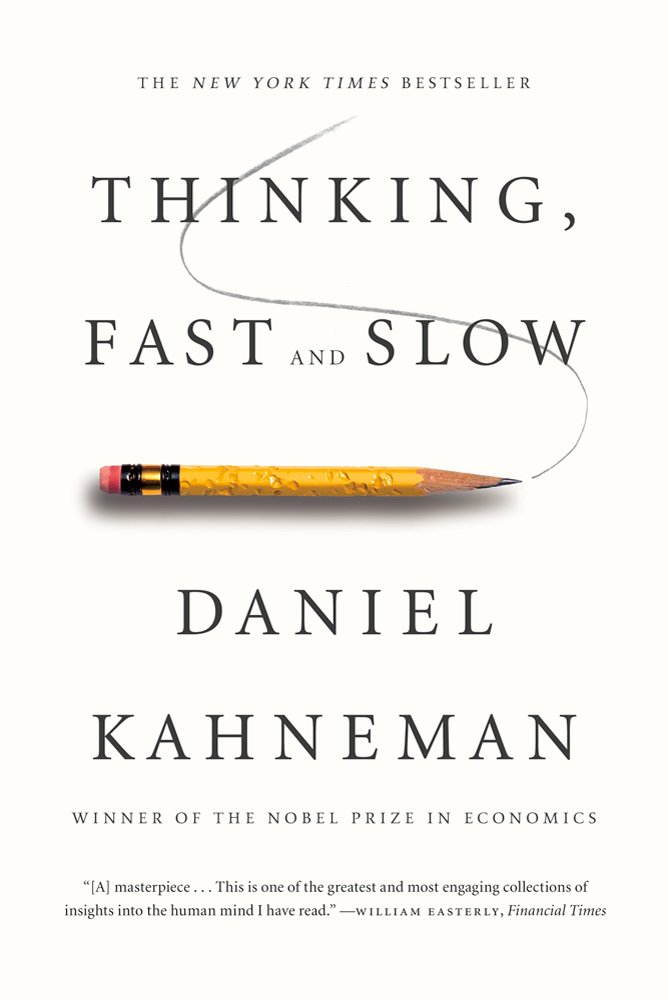
THINKING, FAST and SLOW, by Daniel Kahneman

THINKING, FAST and SLOW


By Daniel Kahneman


In this review, I am going to introduce to you a guide to the world of thinking and thinkers. A masterpiece for any lover of decisional economics, and I guess, also for philosophers.
I apologize for the almost two months without writing a single word on my blog. Lately I have pretty busy with a project which took away most of my spare time besides my professional life.

However, I can affirm that the nature of this book might be favourable to a mid-term reading approach, You'll be often provided with brand new terms and concepts which will require a good amount of research, focusing and thinking in order to be digested.

I would define this book as a "novel of statistics", with a careful and systematic order of contents and a strong propension to story-telling. All the effort of the author to facilitate readers' comprehension is to be noticed in all chapters. In fact, besides the accademic content, the book could be read by anyone with a slight passion for economics - or for psychology, although a lack of knowledge within the ad hoc terminology will certainly determine a slower reading. His "adapted" writing style detach itself from accademics writing at least as much as to allow a smooth reading rythm.

"A life-long trip into rationality" is how I would define the life of Daniel Kahneman, a Nobel-Worth Economist/Psychologist - rather than just a Nobel winner - who revolutioned our way to think of decision, declassing the utility theory and finally introducing the prospect theory.

This book will let you face many truths that are all but easy to accept. We, Humans, are exposed to a great number of factors influencing our decisions, many of them taking life into our some mind, and often generatin inconsistent decisions coming from the same individual. The subdivision of our brain - or at least of his way to function - into 2 Systems called "system 1" and "system 2" is in my opinion Kahneman's biggest intellectual property. This frame allow a great understanding of the differens phases involved in the thinking process, then related to the decision making process.

A wonderful feature of this reading is to be found at the end of every single chapter. Here, many citations of the researchers who worked with him are given to the readers as a present. I really enjoyed many citations, and many of them helped me understanding concepts and more generally the presented theories.

You should consider to get this book if:

  • you are studying economics or psychology (or you are interested in them)
  • you are a more conservative economist and you would like to challange your convinctions
  • you would love to get to a deeper meaning of "rationality"
  • you want to know to which extent our intuitions are to be trusted
  • you would like to discover if your will to undertake a particular choice is biased by something you can't see (nor think of)
  • you love behavioural statistics

I seriously believe that this book changed my way to approach decision making. It made me aware of more types of bias I was not aware before the reading. As I think the author would appreciate, I can state that this book won't keep me away from taking inconsistent decisions, but it will, however, give me a great basis to learn how to set "alarms" that will inform me about the occuring of a situation in which I am more likely to face a specific type of bias.


Best quotations on my opinion:

"The most coherent stories are not necessarily the most probable, but they are plausible, and the notions of coherence, plausibility, and probability are easily confused by the unwary".

"You will occasionally do more than your share, but it useful to know that you are likely to have that feeling even when each member of the team feels the same way."

"Remember that System 2 is lazy and that mental effort is aversive."


I would like to thank Professor Kahneman as well as the researchers who helped him achieving his goals. This book should be a part of everybody's life, for a world of knowledge and progress.
_______________________________________________________________________________

Thank you for reading my review, feel free to comment and share my post, keep checking my blog for further reviews or visit my Visualizza il profilo di Enrico Porceddu su LinkedIn .


If you are wondering, I do not receive any kind of benefit from any person, institution or company for writing my reviews.


Following this book:

SHARING IS GOOD
by Beth Buczynski

FREAKONOMICS
by Steven D. Levitt and Stephen J. Dubner

domenica 12 aprile 2015

THE ALMOST NEARLY PERFECT PEOPLE by Michael Boot

THE ALMOST NEARLY PERFECT PEOPLE
(Behind the Myth of the Scandinavian Utopia)


By Michael Boot


Considering my past which saw me spending one beautiful year in the cold Sweden - including two trips to Finland -, this book was a great occasion to reflect on how Scandinavia and its peolple changed my way to be and my expectations. I can definitely say I found myself understanding the point of view of the author all the 406 pages long, even if, a couple of times, I could not agree with his hypothesis. Nonetheless, I think this is exactly what made up my reading experience, hence trying to compare my point of view with his way to analyze facts. Moreover, he referred several times to other scandinavian anthropological readings, I think I will get them all sooner or later.

A mix of history, politics, philosophy and much more makes of this book a pleasant and interesting reading, and, as it is usual among the books I normally select, a good portion of statistics contribute to improve readers' overall comprehension. Its language is far away from the "ultra-fluent" American English we would find in Dubner and Levitt's global best sellers, but by taking advantage of an infinitely wide range of adjectives - sometimes carefully selected from slang British - the author determines his way to be bold and provocative.

Along this reading you will be questioning in their deepest meaning topics like: Social Democracy, Neutrality, Censorship, Prohibitionism, Propaganda, Atheism, Capitalism, Feminism, Parenthood, Childhood, Happyness, Privatization and much more. You won't miss a chance to get your head working, trust me you won't.

Moreover, I also appreciated his way to show - on purpose - his imperfection, represented by the difficulties which pop up when trying to understand someone else's culture. I personally experienced this, believe me, if you are Italian it is hard to have an high-school teacher who tells you "I think that you should...." instead of "You must....". I mean, I was 18, and I kind of needed teachers to look pretty sure when teaching something to me. But now, after five years, I see their point, and I can say that if somehow I am to become a teacher, I'll also opt for the "I think that you should..."

So to start, I think that you should not miss this book if:

  • you studied scandinavistics or you are interest in Scandinavia
  • you are a politician or you want to become one
  • you spent a part of your life - even a minimal one - in Scandinavia
  • you are thinking of moving to one of these countries
  • you study or you are stongly interest in anthropology
  • you want to understand whether you prefer to be dependent on your state or on your family

Finally, a question came out of my brain at the end book after I read the epilogue, maybe the one question I would like to ask him if I was given a chance to ask only ONE question... You know, we Readers are curious people, we know how damn hard would be to ask just one question after 400 pages...

Here it is:

What's the matter with the Republican-Monarchical discussion... intend as: Why do you question how it comes that they couldn't escape from the monarchy, instead of asking how can it be that they did not find an innovative alternative to Republic State or Parliamentary Monarchy? .... which are by the way old solutions which are constantly failing to make our World a better place....

Best quotations on my opinion:

"To ask your host whether you should take off your shoes is to imply a reluctance to do so; the polite host might not want to impose, but will the secretly despise you for sullying their floors".

"To achieve authentic, sustained happiness, above all else you need to be in charge of your life, to be in control of who you want to be, and be able to make the appropriate changes if you are not.


Thanks to the author for his outstanding work.
_______________________________________________________________________________

Thank you very much for reading! Hopefully my review was a determinant factor leading you to either purchase the book or simply borrow it. Keep reading, keep writing, keep thinking! Feel free to comment and share my post, I hope you enjoyed it.

Check my Visualizza il profilo di Enrico Porceddu su LinkedIn

Just in case you are wondering, I do not receive any kind of benefit from any sponsor for writing my reviews.


Following this book:

FREAKONOMICS
by Steven D. Levitt and Stephen J. Dubner

THINKING, FAST and SLOW
by Daniel Kahneman

sabato 28 marzo 2015

THINK LIKE A FREAK, by Steven D. Levitt and Stephen J. Dubner

THINK LIKE A FREAK
(How to think smarter about almost everything)


By Steven D. Levitt and Stephen J. Dubner


Also this time, the authors of Freakonomics and Super Freakonomics won't miss the chance to let you think quite more intensively than you usually do. Just as the last two books, also "Think like a Freak" is in good part talking about incentives of all kinds. Considering this, this book can be read also independently but you should read the other two either after or before since they are very connected.

This time, their will to make the reader think is more explicit. Their approach sounds pretty much like "ok now take a couple of minutes/hours and think about this" then you may keep reading,  Their bold way to comunicate is the core of this reading, as an added value to the carefully selected cases reported within the 268 pages of the book.

I think that most of the situations described in this reading - most of them accompanied by clear statistics - are to be interpreted at least twice. In fact, they will provide an overview and eventually a solution of a specific problem (be this the security and safety of a concert's stage, or the need to let the entire world believe in what you say etc.),  before applying that problem and that solution to a more general context. They kind of give away life-shortcuts for complex situations that require a lot of thinking efforts. Personally, I loved the paragraph

If you are a curious person, asking yourself too many questions, this book my represent the key to answer some of those questions. Its language is direct and it totally lacks technical words, or at least, whenever one of these words is presented, it is also explained.


Best quotation on my opinion:

None of us want to look stupid, or at least overmatched, by admiting we don't know an answer. The incentives to fake it are simply too strong.

*Talking about: why is it so hard to say I don't know
_______________________________________________________________________________


I hope you found my post useful and that therefore you'll decide to buy/read this "commercial marvel" which makes you think. Please feel free to write me if you have any question! Keep reading and thinking.

Just in case you are wondering, I do not receive any kind of benefit from any sponsor for writing my reviews.


Following this book:

FREAKONOMICS
by Steven D. Levitt and Stephen J. Dubner

THE ALMOST NEARLY PERFECT PEOPLE 
(Behind the Myth of the Scandinavian Utopia)
by Michael Booth